Visualizzazione post con etichetta General Synod. Mostra tutti i post

domenica 31 ottobre 2010

Summary from the Drafting Commission: 31 October

> odt. pdf. rtf. text. word. html.


The closing session began with a prayer reflection led by Fr Orven Gonzaga. The session was chaired by Fr Luigi Vaninetti, who began by saying that the session would consist of four parts: the reading by the Synod Secretary of the decisions taken by the Synod; a statement from the General Econome on the expenses of the Synod; a verbal evaluation of the Synod on the part of the Synod members; the Superior General’s concluding remarks.

Fr José Luis Quintero then read the text of the six proposals which had been agreed by the Synod. These are: the proposal on the Solidarity Fund from the Commission on Solidarity in Finance; the proposal to study the question of criteria for the viability of provinces and the situation of the vicariates in preparation for the 2012 General Chapter; the proposal on giving decision-making powers to the configurations; the proposal that the General Council consult our own religious and the members of the various Passionist lay movements and examine the situation of the various groups, with a view to including references to our Passionist lay movements in both the Constitutions and the General Regulations; the recommendation to provinces regarding the eligibility of Passionist Brothers to the role of First Consultor; the proposal that the configurations continue to operate until the 2012 General Chapter.

The General Econome, Fr Battista Ramponi, then gave the Synod members a detailed breakdown of the costs incurred during the Synod, including travel to Rome for Synod members, food and lodging, rental of equipment for the secretariat and translators, costs for facilitators and invited speakers. He compared these to the costs of the last General Synod in Cuernavaca and the last General Chapter in Rome. He explained how the costs, including travel, would be redistributed around the provinces, vice-provinces and vicariates according to their ability to pay, following the same percentages used for the annual contributions to the General Administration.

sabato 30 ottobre 2010

Summary from the Drafting Commission: 30 October

> odt. pdf. rtf. text. word. html.


Fr Franz Damen was the principal celebrant at the Mass which was celebrated in Spanish.

The morning session was chaired by Fr Denis Travers. It was preceded by a prayer reflection; the theme was ‘The Passion of Jesus – The bridge which unites us’, based on no. 5 of the Constitutions.

Fr Michael Mullins introduced the day’s work. It is difficult to deal with matters ad experimentum. Here we need to suspend judgement, particularly canonical judgement. This is a new way of acting, a systemic way. The future of the configurations will largely depend on the quality of leadership, particularly at local level. A key element is dialogue at and across the different levels; in this area we learn by doing. Reports on yesterday’s questions and reflections were then heard.

The Sacred Heart Configuration report spoke of uncertainties about the future and the fear that the Synod has not gone far enough but has seemed to be going backwards. We want to continue on the road chosen at Cuernavaca. This configuration wants to become a single province with zones. The configuration has a list of initiatives, including a formators course in Rome next January, provincial chapters in the three provinces and an assembly in the vice-province, and various inter-provincial events, including the World Youth Day. The configuration intends to keep the same co-ordinator.

venerdì 29 ottobre 2010

Summary from the Drafting Commission: 29 October

> odt. pdf. rtf. text. word. html.


Mass today was celebrated in language groups.

The morning prayer reflection was on the theme of having the mind of Christ crucified; it was led by Fr Giovanni Cipriani. The session was chaired by Fr Luis Alberto Cano.

An update was given on the situation of Fr Mario Bartolini in Perú. The Synod members had seen a news report which was broadcast on television yesterday. Today they received fresh information from our religious and sisters there about the present state of the case.

On behalf of the interprovincial Passionist Youth Ministry Team in Spain, Fr José Maria Saez gave a presentation about the World Youth Day in Madrid in 2011. It is important for us as a Congregation to be present at the WYD, as the sign which defines this encounter is the Cross. There will be a meeting of young Passionist religious at Peñafiel from 12 to 14 August. Groups of young people who are part of the Passionist family will be welcomed at Alcalà de Henares during the WYD, from 15 to 21 August. The special Passionist day, referred to in the General’s letter on the WYD, will be on 18 August. Those interested in taking part should contact the Youth Ministry Team and also, in the case of the Meeting of Young Religious, the Secretary General here.

giovedì 28 ottobre 2010

Summary from the Drafting Commission: 28 October

> odt. pdf. rtf. text. word. html.


Mass for the Feast of Saints Simon and Jude was celebrated by Fr Joachim Rego.

The morning prayer reflection was led by Fr Giovanni Cipriani. The session was chaired by Fr Luigi Vaninetti.

The first item was a proposal from the Commission for Solidarity in Finances that all entities should contribute annually 2% of the gross income of their entity’s administration to the Solidarity Fund, and that the Synod should confirm the decision of the last General Synod that 7% of the proceeds from any sale of immobile goods (lands or buildings) be contributed to the Solidarity Fund.

A number of clarifications were sought, some in relation to cases where civil governments have requirements linked to the sale of property. Other issues raised included the following: Criteria for the running of the Solidarity Fund were established some time ago and could be revisited. There is a need for co-ordination between funding solidarity at configuration level and at the level of the whole Congregation. Should the Solidarity Fund and Formation Fund be united or remain separate? It would be useful for the Commission to meet with the economes or finance managers of the different entities. Even with these fixed contributions, voluntary contributions to the Solidarity Fund can still be made. After discussion, the proposal was carried with no dissenting voices.

The Superior General then gave the third part of his report. Among issues referred to in the report were: the need to include within our Constitutions and General Regulations a reference to those laity who seek to live our Passionist Charism and be associated with our Congregation; the importance of historical research and publications on our Congregation and its provinces; the work of the Commission for Communications and the setting up of a permanent office for communications; the need for norms to guarantee the safety of financial funds; the ‘two pulses’ of the heart of our Charism, which are (a) Contemplating the Passion of Jesus and living in fraternal and poor communities, located in solitude (b) Announcing the contemplated word of the Cross, giving preference to abandoned places and recognising Jesus in the suffering and the poor); our presence at the U.N. through Passionists International; the need for adequate policies throughout the Congregation for dealing with questions of sexual abuse and promoting the safeguarding the vulnerable; training for formation personnel; the role of brothers in leadership; the required number of houses and religious to constitute a province. 

Report of the Superior General to the XIV General Synod (part three)

> odt. pdf. rtf. text. word. html.


1. Reminders.
a) Participation in the General Chapter. According to what is prescribed at No. 130 of the Constitutions and the General Regulations (GR) that determine the number of delegates to the General Chapter. What is prescribed by the G.R. at No. 77 was modified and approved at the General Synod of 2004 and confirmed at the last General Chapter of 2006.
b) Participation at a General Synod. According to No.147 of the Constitutions, the members of the Synod are those who participate at the General Chapter “ex officio”.
c) Modifications to the Constitutions. According to what is prescribed by No. 114 for the modification of any point of the Constitutions a two thirds majority of votes in favor of the change, and in order for it to become part of the text of the Constitutions, it needs to be approved a second time at the successive General Chapter.

2. The Laity. 
The Lay Passionist movements, with various titles throughout the world, are becoming more and more aware of their being called to our charism and to our mission. They exist, they are involved in formation and are collaborating among themselves and the number of those who are consecrated to the Passion as laity is increasing. We know that St. Paul of the Cross wrote numerous letters to lay men and women, trusting in their capacity to live the spirituality of the Passion.

However, neither in our Constitutions nor in our General Regulations is there is any reference to the laity being called to our charism. I believe that the time has arrived for their inclusion in the Constitutions and in the General Regulations as individuals who are associated with the Congregation. A small commission has proposed inserting into the Constitutions the following provisional text that is intended for study and therefore can be modified: “There are persons who feel an attraction (calling) to the charism of the Passion and who wish to live it in communion with the Passionist Congregation. When they are formally associated with the Congregation, according to the norms established in the General Regulations, they will form an integral part of the Congregation as the Passionist Family.”

It is suggested that we place this text or something similar, at the end of Chapter II of the Constitutions, the chapter on Community Life, following No. 38. In fact, in that chapter, in addition to the elements of community life, it speaks about the relationship with those outside the community and hospitality. The General Regulations should contain one or two points that define the forms of association and the specific relationships between the laity of the Passionist Family and the Congregation [...]

| Download | Report of the Sup. General to the XIV General Synod (part three)

Download Part One / Part Two

| Download | Report of the Sup. General to the XIV General Synod (part one)
| Download | Report of the Sup. General to the XIV General Synod (part two)

Versione italiana Versión en español

mercoledì 27 ottobre 2010

Summary from the Drafting Commission: 27 October

Google docs: download 
> odt. pdf. rtf. text. word. html.


Mass today was celebrated in language groups.

The morning prayer reflection was on the theme of listening and discernment. The opening session was chaired by Fr Denis Travers and began with an update from Fr Juan Maria Santamaria on the situation in Yurimaguas, Peru.

Sister Christine Anderson f.c.j. then introduced the morning’s work. One of the main tasks of this Synod is looking at the viability of the configurations. The configurations were an experiment in solidarity in formation, personnel and finance; now the experiment has to be evaluated. Human beings find difficulty in changing, but we have within us the resources needed for change. These are: 1) an open mind, the enemy of which is judging before we have heard everything; 2) an open heart, which allows us to get in touch with our vulnerability, and here the enemy is cynicism; 3) an open will, from which comes the desire for what is best for the mission and values of the Congregation; the enemy here is fear or doubt. The evaluation would be done in configuration groups. The groups were asked to look in a critical way at their own configuration and ask themselves if it is viable. Sister Christine suggested a viability tool, consisting of six areas for examination: 1) leadership capacity, strategic thinking, focus on Passionist mission; 2) government structures, decision making; 3) financial planning, accountability; 4) initial formation, ongoing formation; 5) communication networks, relatedness to General Council and other configurations; 6) in the light of all this, can you say you are working effectively towards solidarity of formation, personnel and finance within your configuration? Has your configuration the capacity to offer solidarity to other configurations? The Synod members were now invited to go into configuration groups, after a period of personal discernment. The groups were given two questions: Do you think the composition of your configuration is viable or do you suggest any changes? Regarding the other configurations, have you suggestions to make them increase solidarity in formation, personnel and finance?

martedì 26 ottobre 2010

Summary from the Drafting Commission: 26 October

> odt. pdf. rtf. text. word. html.


The day began with Mass in the Retreat House Chapel celebrated by Fr Leone Masnata.

The morning session in the aula, chaired by Fr Clemente Barron, was preceded by a prayer reflection celebrating the centenary of the Passionists in Brazil. Fr Michael Mullins s.m. informed the Synod that the dialogue in response to the reports from configurations would be take place in a single group in the aula. He asked us to ensure that all voices are heard, and gave this background question: What are the key issues that the Synod has to address for the whole Congregation?

Fr Leone Masnata presented the report on behalf of the Configuration of Blessed Eugene Bossilkov. Initially the seven entities of the configuration looked at the following: replies made by provinces of the configuration to the template on restructuring; possible future shape for the configuration; choosing common projects in the areas of solidarity (formation, personnel, finance); decision-making powers of the configuration; ways of consulting the religious of the various provinces on their opinion of the viability of the configuration. The four Italian provinces of the configuration and the French province wish to work towards becoming a single province, with five regions, while ASSUM and VULN wish to continue as distinct entities within the configuration. The configuration has a study group, divided into three sub-groups (formation, personnel, finance), and a permanent secretary. The Italian entities have a common novitiate and student house. Various forms of collaboration exist, including support for the mission in Bulgaria and the house in Lourdes. 

lunedì 25 ottobre 2010

Summary from the Drafting Commission: 25 October

> odt. pdf. rtf. text. word. html.


Masses this morning were celebrated in language groups.

The sessions in the aula, which was chaired by Fr Denis Travers, began with a prayer reflection on the theme ‘The Seed of the Passionist Charism Scattered in Many Places’, which recalled the sixty different countries in which our Congregation has been established.

The first session was devoted to the second part of the report of the Superior General, Fr Ottaviano D’Egidio, entitled ‘Starting afresh after Cuernavaca’, a summary of which is given here:
Fr Ottaviano listed the various stages gone through in the process of restructuring, beginning with the General Chapter of 2000. A turning point in the process was the 2008 Synod at Cuernavaca during which six new configurations were established, responding to a new awareness that every part of the Congregation is responsible for the other. During the two years leading up to this Synod, the task of the configurations was to evaluate and experiment with the viablity of the composition of each configuartion as a hypothetical structure for the future. However, the process of examining the feasability of the new configurations will not end with the present Synod. During the next two years, we will move towards defining conclusively the new entities and the model of government to be used both at General level and at the level of the configurations. The juridic consequences also need to be clarified during the next two years.

The General then spoke of the meetings of co-ordinators which have taken place and summarised the different directions in which the six configurations are going forward. As, at the level of the configurations, discernment should result in decisions, he suggested that the configurations should be able to make decisions and act on them and, on behalf of the General Council, proposed a text to this effect for the evaluation and approval of the Synod. He also reflected with the Synod on the Congregation’s history of expansion and development, the meaning of solidarity in practice, and the means for achieving a culture of solidarity within the Congregation.

domenica 24 ottobre 2010

Summary from the Drafting Commission: 24 October

> odt. pdf. rtf. text. word. html.


The day began with Mass celebrated in the Chapel of Saint Paul of the Cross. The principal celebrant and homelist was Fr Antonio Munduate.

The morning session, which was preceded by a prayer reflection prepared by the STIP students, consisted of two talks given by Fr Aquilino Bocos Merino C.M.F. on Restructuring in the Passionist Congregation. Fr Aquilino is a former Superior General of the Claretians who is working for the periodical ‘Vida Religiosa’ and for the Theological Institute of Religious Life in Madrid. The session was chaired by Fr Luis Alberto Cano.

Fr Aquilino’s first talk covered three topics: the meaning of restructuring; obstacles and opportunities; the ultimate reason for restructuring. In the second talk, he treated these aspects: presuppositions required to make restructuring effective; the relationship between the Congregation and its major organisms (provinces, vice-provinces, vicariates); motivation and co-responsibility in structural innovation; final considerations.

Restructuring is a principle of healthy realism: Fr. Aquilino Bocos Merino, CMF


The expression "Restructuring is a principle of healthy realism" was used by the preacher and it summarizes the key point and the perspective of Fr. Aquilino Bocos Merino’s presentation. Thanks to his personal experience, as former General of the Claretians and his academic studies, he guided us through a spiritual but also realistic reading of a transformation and renewal process like the Restructuration process that we are undertaking.

What is most needed in order for this process to bear fruit is conversion that is personal and profound. We need to work so that religious life maintains its prophetic and meaningful dimension in order to be able to heal the wounds of the modern world.

In this way our efforts to elaborate and to implement new structures and organizations will make our charism efficacious in world of today. The specific mission - the one that make us preach the cross each day - should be the measure of our planning efforts.

Versione italiana Versión en español

Reflection Day: Fr. Aquilino Bocos Merino, CMF

Merino2
The first Sunday morning of the Synod was dedicated to a special day of reflection on “Restructuring in the Passionist Congregation” guided by Fr. Aqulino Bocos Merino, CMF. The following information will introduce  him. Fr. Aquilino Bocos Merino started his activity by teaching philosophy in the Claretian Seminary of Segovia, completed his studies in philosophy at the Pontifical University of Salamanca and was on the formation staff of the International Claretian Theologate of Salamanca and spiritual director of the Maronite Major Seminary of the same City.

Holy Mass: homily for October 24th

30th Sunday of Ordinary Time
Gospel of Luke 18,9-14

The Word of God, which is proclaimed on this Sunday Liturgy for the 30th Sunday of Ordinary Time, invites us to review our relationship with God—which is our prayer life; and asks how is our relationship with our brothers and sisters. Let us remember that contemplating divine realities and union with God through prayer ought to be the first and primary obligation of all religious (canon 663). This prayer is certainly not be overlooked on this World Sunday for the Propagation of the Faith (DOMUND*), “Our prayer thus takes on a hidden apostolic fruitfulness for the People of God, and echoes our solidarity with our brothers and sisters, especially the poor and suffering” (Const. 38).

sabato 23 ottobre 2010

Summary from the Drafting Commission: 23 october

> odt. pdf. rtf. text. word. html.


Mass was celebrated in the Retreat House Chapel; the principal celebrant was Fr Michael Ogweno.

The first session in the aula began with a prayer-reflection on the theme of Solidarity and Mission, prepared by the students of the STIP (Passionist Inter-provincial Student Community).

Fr Luis Alberto Cano chaired the session. He began by asking the Synod if they wished to extend the right to vote to the three invited guests: Fr Antony Sikhalele Mdhuli (Regional Vicar, MATAF), Fr Moisés Ríos (Regional Vicar, PAC) and Fr Michael Ogweno (Co-ordinator, CPA). All agreed.

The General Econome, Fr Battista Ramponi, gave a written report on the income and expenditure of the General Curia and also of the Saints John and Paul Community for 2007, 2008, 2009 and the first half of 2010. He also gave similar information regarding the Formation Fund, the Solidarity Fund and funds administered by the Generalate on behalf of other entities. In his comments on the report, Fr Battista raised the question of a Congregational Common Fund, which he had proposed at the last General Chapter, as an aid to the General Administration which, until the present, is resourced solely by contributions from the provinces.

The Passionist presence at United Nations


Fr. Kevin Dance - who is our delegate at the NGO Passionists International, spoke to the assembly about the activities that we are undertaking at UN. After recall his personal "adventures" during the difficult times of the beginning of the project, he described the working dynamics of the organizations that are now operating in that area; he explained to the Synod not only the motivations that led us to begin our presence in that particular context, but also the actual contribution of our work there and how we are influencing the UN dynamics.

Versione italiana Versión en español


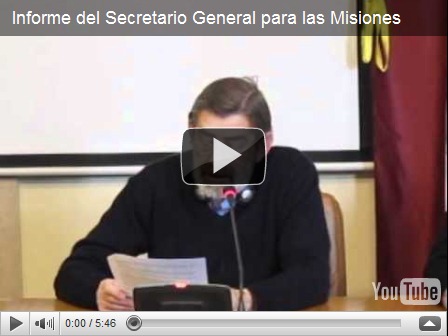
The Report of the General Secretary for Solidarity and Mission


P. Jesus Maria Aristin, General Secretary for Solidarity and the Missions, updated the synod members with his report about the activities recently undertaken by his office. He underlined the importance for supporting the development of local JPIC initiatives, that do require the engagement of more Passionists that specific area. Then Fr. Jesús reaffirmed – as was already stated at the pre-synodal workshop - that our engagement in JPIC is an expression of our charism, therefore it is an important aspect of our mission.

Versione italiana Versión en español

Holy Mass: homily for October 23rd

29th Saturday of Ordinary Time
Gospel of Luke 13,1-9

When some people arrive to tell Jesus of the tragedy and misfortune that befell some Galileans and sort of suggested that they were more sinners than the rest of the Galileans, Jesus takes the opportunity to refute that kind of a mentality; a mentality that is not totally alien to us. It is common for us to think that when everything is going on well; when we have everything we need and have stocked enough for the foreseeable future, it is because of our hard work and better planning.

That the good life is a reward from God for something good we did just as misfortune is a punishment for something bad. We often then keep away from those who seem to move from one disaster to another; some times out of fear that their misfortune can come to us; that they can taint or contaminate us. And while we sometimes feel sorry and pity them, we do not really identify ourselves with them. We suspect that their tragedy, misfortune, pain and sufferings is caused by something wrong they did or failed to do.

ogweno3Jesus tells his listeners as he tells us today, that misfortune, tragedy and sufferings are no sign of greater sins in those who suffer them. We all share a basic similarity with those who suffer in any way. Everyone, says Jesus, is a sinner and therefore in need of repentance. Unless you repent, you will all perish as they did! Disaster, accidents and sufferings are not inflicted on people by God as a punishment for sins. The God of Jesus Christ, our Father, is intrinsically a God of love, who is merciful and generous to all his people including those we would want to categorize as sinners. His mercy and generosity towards us, is an invitation to us, to in turn be merciful and generous with one another.

No one should look at his gifts, resources and think he deserved better than the other, or look upon anyone who does not have as being punished for something he did or failed to do. Whatever life and prosperity anyone has is to be understood, seen and received as a complete gift, given by God simply because God has chosen to do so, out of his generosity and not because anybody deserved better than the other. God cares for all and he demands that we do the same for one another. Unless you repent you will all perish as they did!

Solidarity with Fr. Mario Bartolini: letter of General Father

Dear father Mario, we’re sending you this letter from Rome where we’re in the midst of our Passionist General Synod at our General House of Saints John and Paul. The Synod is being attended by our Superior General and his Council and all the Provincial and Vice-Provincial Superiors and Regional Vicars who reside in some 60 different countries around the world, amongst them Perú.

At the end of the first day’s session, during which we dealt with the theme of Justice, Peace and the Integrity of Creation, we would like to send you our brotherly greetings and encourage you to continue with your mission and maintain your peace of mind and serenity in the midst of all that is happening to you. We have been following events from some time back and we have always appreciated the work you did together with Father Pio Zarrabe Garro, C.P., now passed away, in defense of the peasants’ land in the Amazon region of Perú, where you are serving loyally as a parish priest.

We are fully aware of the legal problems you are involved in as a consequence of your efforts in defense of small landowners in Barranquita where you minister. Small parcels of land which are nevertheless are all that the people of your flock possess and which they work in order to feed and clothe their families, including their aged parents.

venerdì 22 ottobre 2010

Summary from the Drafting Commission: 22 october

Google docs: download
> odt. pdf. rtf. text. word. html.


The day began with the Opening Liturgy, celebrated at three ‘stations’. In the Atrium of the Crucifix, after prayer and sacred reading, lanyards were conferred on the Synod members who then went in procession to the statue of Saint Paul of the Cross. At this second ‘station’, the co-ordinator of each configuration received a piece of the Synod logo as a ‘Symbolum Fraternitatis’.

After singing ‘Salve, Sancte Pater’, the assembly moved to the aula for the third ‘station’ where the logo-symbol was put together and Synod members attached their lanyards to the completed logo. Then, in the presence of the icon of Mary, ‘Salus Populi Romani’, the Synod members invited the Holy Spirit to be present in their midst.

The opening address of the General Superior of the Passionists


The inspirational address of the Fr. General opened the activities of the Synod. He invited all the member of the assembly to recall the fundamental elements of our charism that were the inspirational principles of the journey undertaken so far. He stressed that we have to root ourselves in the Passionist, but at the same time we have to address the challenges of the modern world. We are profoundly convinced that the Solidarity, that we are trying to implement, is an expression of the Memory of the Passion that is still the remedy for the evils of the World.

Versione italiana Versión en español

The Opening Ceremony


The 14th General Synod of the Passionists has just started. In the video above, you can see the opening liturgy of the Synod: the Passionists gathered together under the cross located in the main courtyard of the Generalate of Sts. John and Paul prayed the Lord during a wonderful autumn day.

After the distribution of same cloth key chains – a symbol of the Solidarity that binds our religious men throughout the world – the opening procession started, moving toward the statue of S. Paul of the Cross . Once there, the Coordinators – the members who had a specific and active role in the animation of the Restructuring process – received a puzzle piece. Our presence there symbolized the deep connection between the journey that we are undertaking and the spirituality of our founder.

After the song Salve Sancte Pater, the synod members went to the Synod Hall. Once there we recomposed the whole puzzle, forming the Synod logo: the representation of the common effort to keep alive the spirit of solidarity, the key theme of the present discernment process. The song Veni Creator concluded the ceremony, by entrusting the Synod and its members to the Holy Spirit. May God’s will be accomplished through their work.

Versione italiana Versión en español